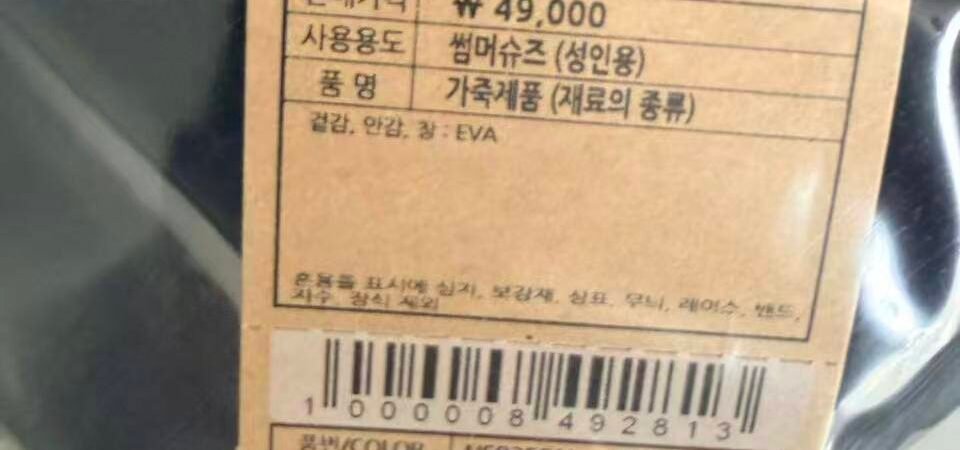
Quick answer: Korean clothing labels often contain more useful information than international shoppers expect. Depending on whether you are looking at a retail hangtag or a permanent care label, you may find the style code, product name, color, size, listed Korean retail price, manufacturer or importer, country of manufacture, fiber composition and care instructions.
This guide explains the Korean terms that appear most often and shows how to read them using original product photos taken in Korea. It is designed for shoppers comparing Korean releases, checking a reseller listing or trying to identify the exact version of an item.
Last reviewed: September 2026. Product details and label layouts can change by brand, product category and season.
Retail Hangtag vs. Permanent Care Label
First, separate two different types of labels:
- Retail hangtag or price tag: usually attached to a new product. It may show the style code, product name, color, size, barcode and Korean suggested retail price.
- Permanent care label: sewn inside a garment. It is the better place to check fiber composition, manufacturer or importer, country of manufacture and washing or care instructions.
A hangtag is useful for identifying a product, but it is not a complete substitute for the permanent care label. If you are buying second-hand or from an overseas reseller, ask for clear photos of both when possible.
Common Korean Clothing Label Terms
| Korean | Meaning | How to use it |
|---|---|---|
| 품번 | Style or model number | Use it to search for the exact product and compare listings. |
| 품명 / 상품명 | Product name | Confirms the model name or product category. |
| 색상 | Color | Often appears as a Korean name, an English abbreviation or a numeric color code. |
| 사이즈 / 치수 | Size / dimensions | May be shown as S–XXL, 85–115, millimeters or ONE/FREE. |
| 판매가격 | Listed retail price | The Korean won price printed for retail sale; it is not necessarily the current market price. |
| 제조국명 | Country of manufacture | Shows where the item was made, not where the brand originated. |
| 제조자명 | Manufacturer | Names the company responsible for manufacturing. |
| 수입자명 | Importer | Common on imported goods sold in Korea. |
| 판매자명 | Seller or distributor | Identifies the Korean business responsible for sale or distribution. |
| 혼용률 | Fiber composition | Shows the percentages of cotton, polyester, nylon and other fibers. |
| 취급상 주의사항 | Care precautions | Explains washing, drying, ironing and handling restrictions. |
| 제조연월 | Manufacture year and month | Useful for identifying production timing, but it is not always printed on the removable hangtag. |
How to Read a Korean Style Code
The field labeled 품번 is usually the most useful starting point. It is the brand’s internal style or model code. Codes may include letters for the product category, numbers for the design and season, and extra characters for a regional or color variation.
Do not assume that every letter has a universal meaning. Each brand controls its own code system, and overseas releases may use a slightly different code from the Korean version. Search the full code exactly as printed, then compare the product name, color, size range and photos rather than relying on a partial match.
For detailed examples, see our guides to The North Face Korea product codes, National Geographic Korea product codes and Marithé Korea product tags.
For cap-specific examples, our New Era Korea tag guide compares two photographed MI codes and explains OSFM sizing and printed won prices.
Size Codes Are Not Body Measurements
Korean clothing may use international letters such as S, M, L, XL and XXL, or numeric sizes such as 90, 95, 100, 105, 110 and 115. Shoes are commonly marked in millimeters. Accessories may use ONE or FREE.
These codes are not guaranteed measurements. A size 100 from one brand can fit differently from a size 100 from another brand, and unisex, women’s and oversized products may follow different patterns. Always compare the brand’s measurement chart and, when possible, the garment’s actual chest width, shoulder width and length.
Our Korean clothing size guide explains the 85–115 system and how it relates to S–XXL.
Real Example 1: The North Face Korea Footwear Tag
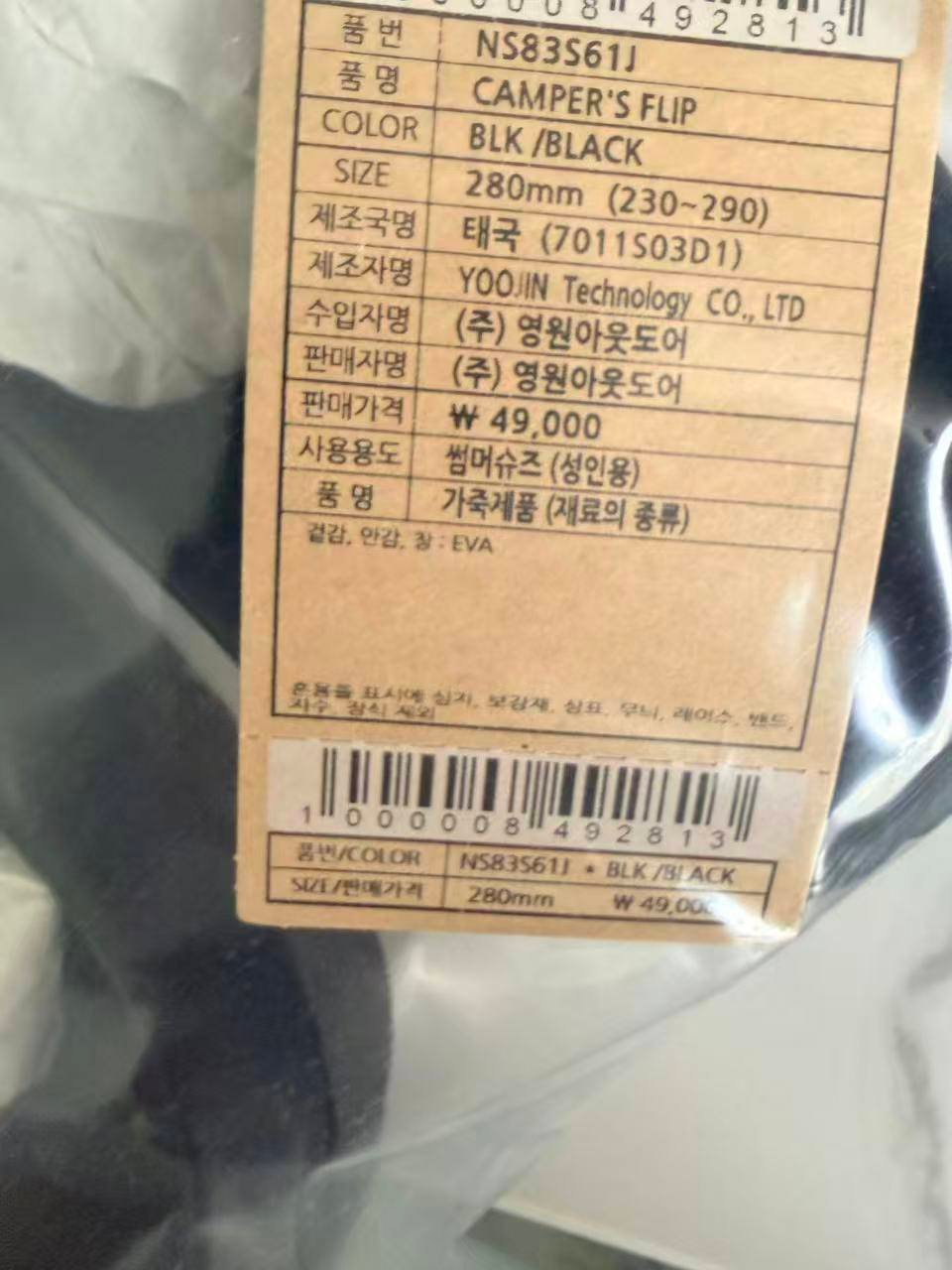
This The North Face Korea tag shows several useful fields in one place:
- 품번: NS83S61J
- 품명: Camper’s Flip
- 색상: BLK / BLACK
- 사이즈: 280 mm, with a listed range of 230–290
- 제조국명: Thailand
- 수입자명 / 판매자명: Youngone Outdoor
- 판매가격: ₩49,000
- Material information: EVA
The 280 mm figure is the selected shoe size. The 230–290 text records the printed size range, not the size of this individual pair or confirmation that every listed size is currently in stock. The printed ₩49,000 is a listed Korean retail price and does not guarantee the current selling or resale price.
Real Example 2: National Geographic Korea Clothing Tag
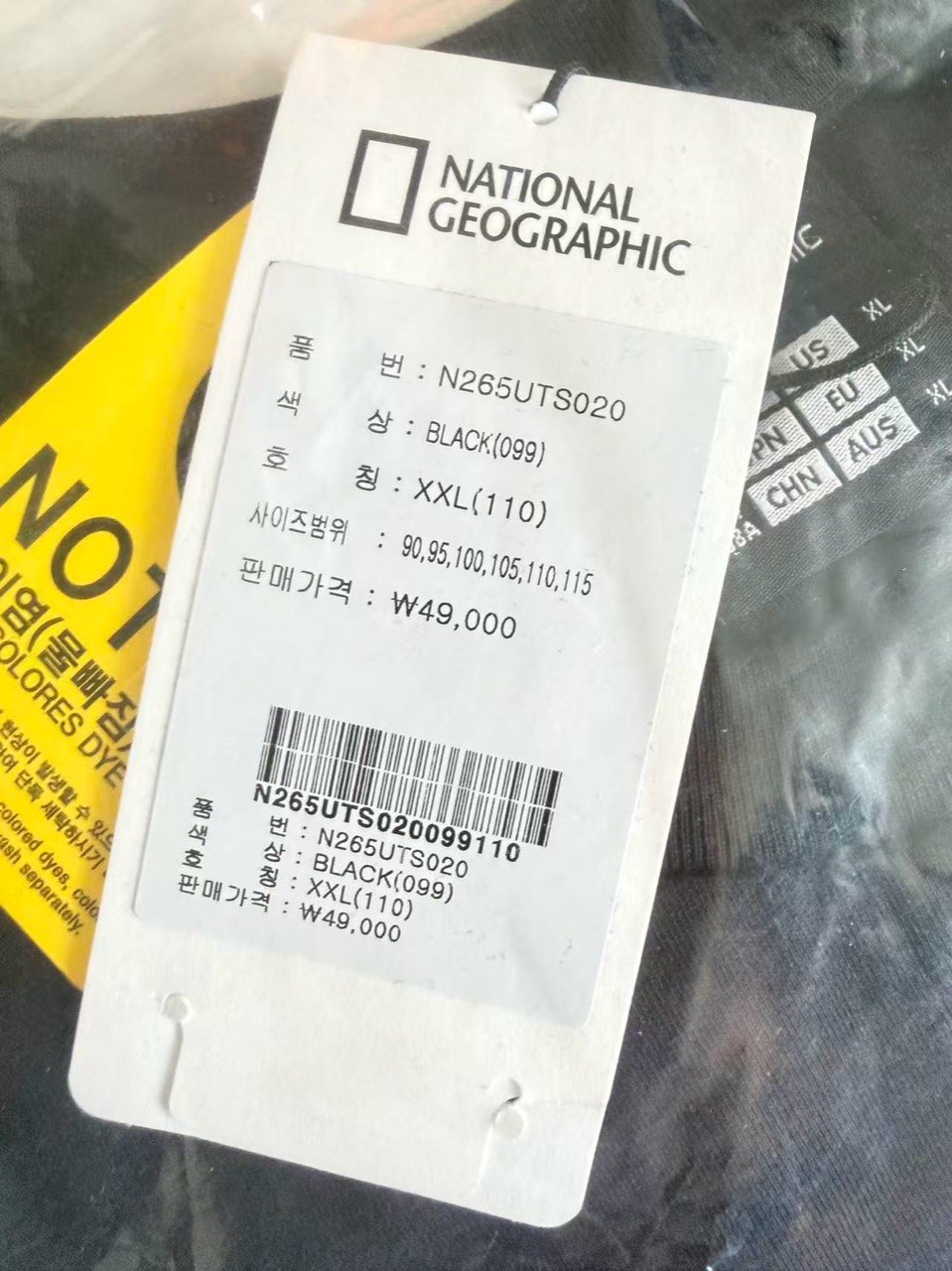
On this National Geographic Korea example, the label shows product code N265UTS020, color BLACK (099), selected size XXL (110), and a printed size range of 90, 95, 100, 105, 110 and 115. The listed price is ₩49,000.
The text printed beneath this barcode reads N265UTS020099110: the photographed style N265UTS020 followed by the visible color 099 and size 110. This is a visual reading of the printed text, not an electronic scan or a universal decoding rule for other brands. It does not establish current stock. A code difference between two listings requires checking the actual product details; it is neither proof of a fake nor proof that the products are identical.
Real Example 3: Marithé Korea Product Tag
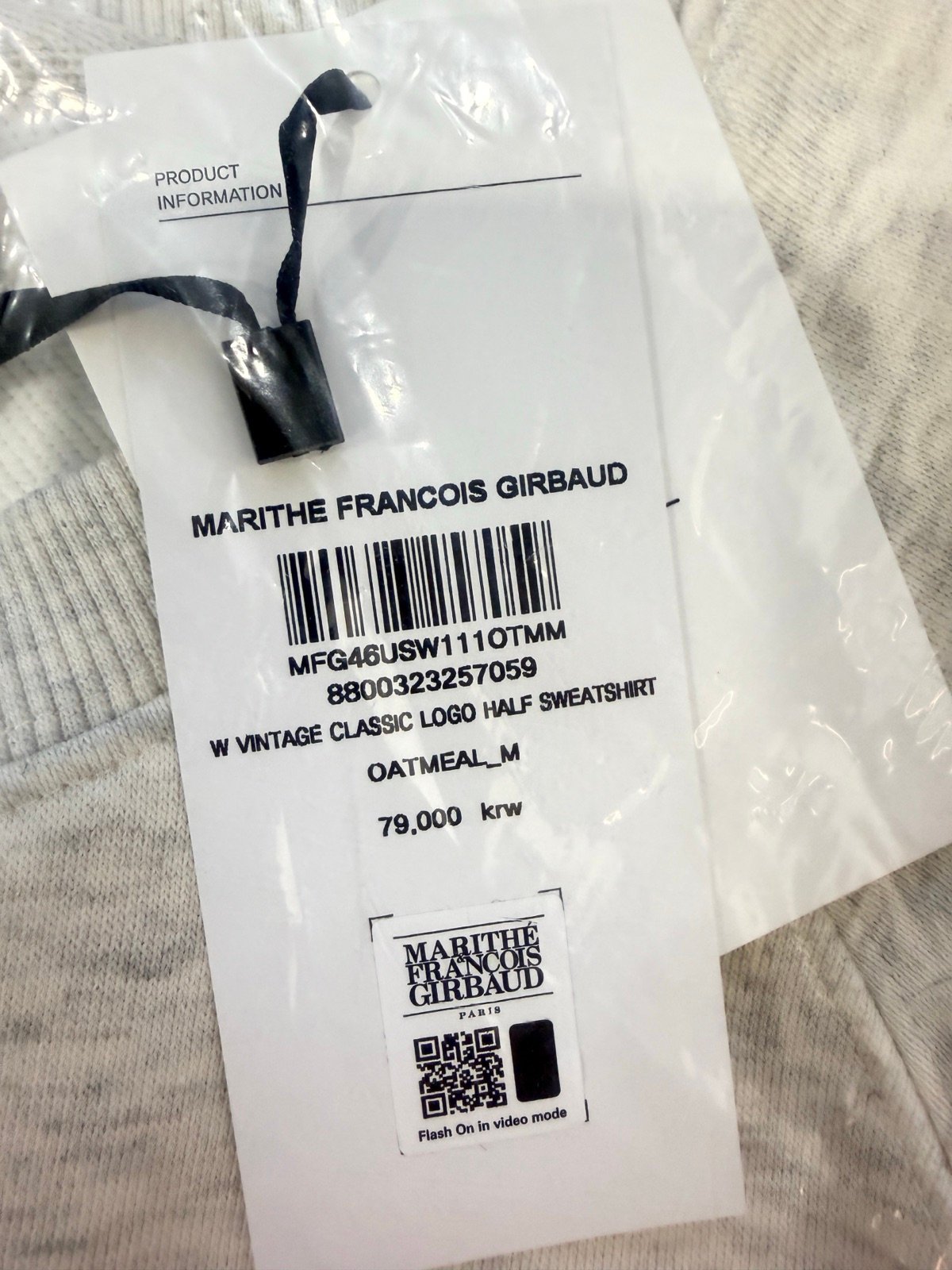
This Marithé Korea tag identifies the style as MFG46USW111OTMM and names the product W Vintage Classic Logo Half Sweatshirt. It also shows the color Oatmeal, size M, barcode and listed price of ₩79,000.
This is a good example of why an exact style code is more useful than searching only the visible logo. It helps distinguish similar-looking sweatshirts, colors and seasonal versions.
Real Example 4: A Backpack Hangtag and Inside Label
The same label-reading method also works for bags. These three original photographs show a The North Face TNF ORIGINAL PACK MINI, with style code NM2DS23B and color WHS / WHITE SAND.
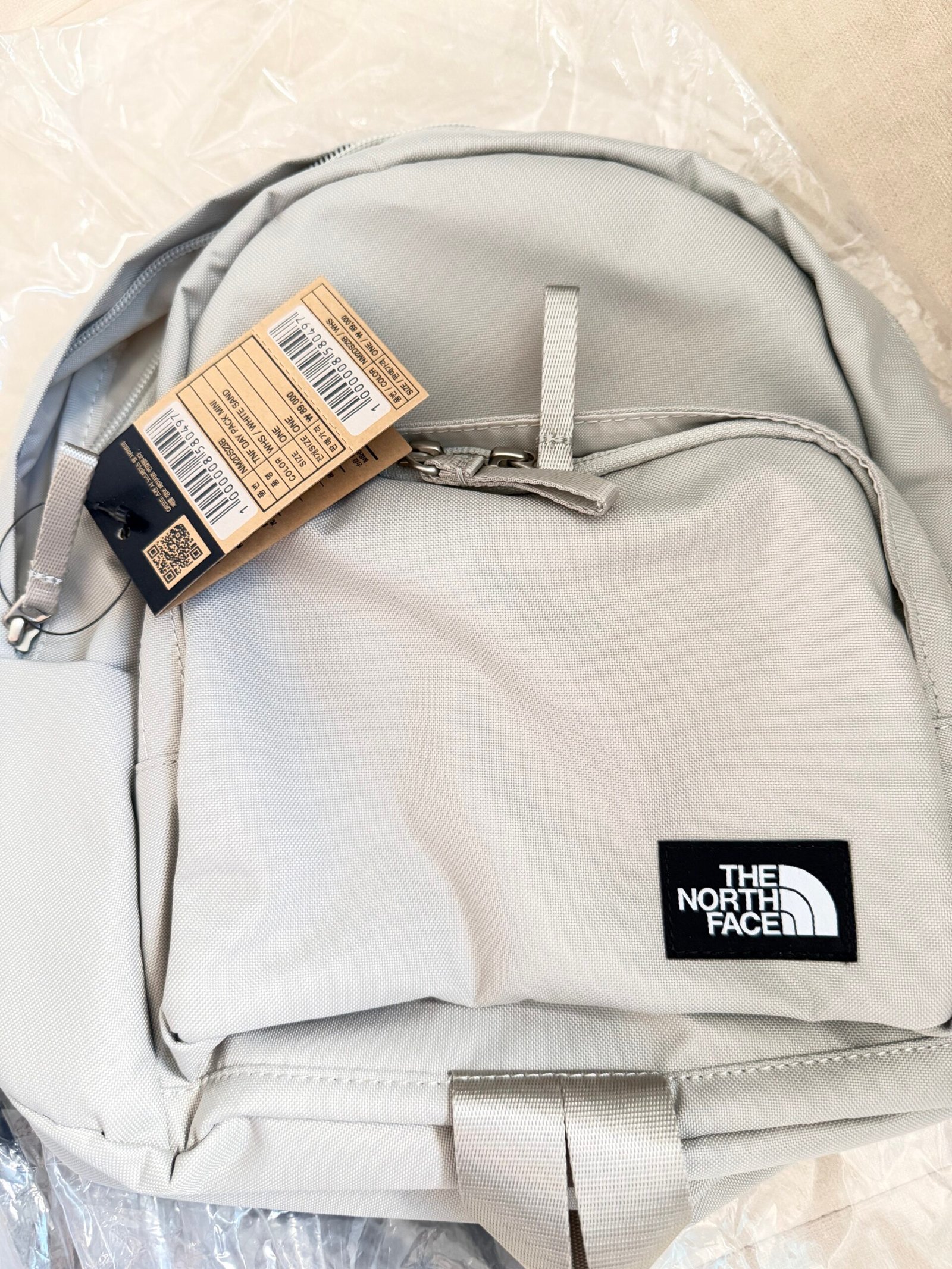
ONE and 10L answer different questions. The hangtag uses ONE as the item’s size designation. A separate sewn-in tab reads 10L, indicating its labeled capacity. ONE is not a capacity measurement, and 10L does not tell you the bag’s height, width, opening size or whether a particular laptop fits. We have not measured its volume or tested laptop compatibility.
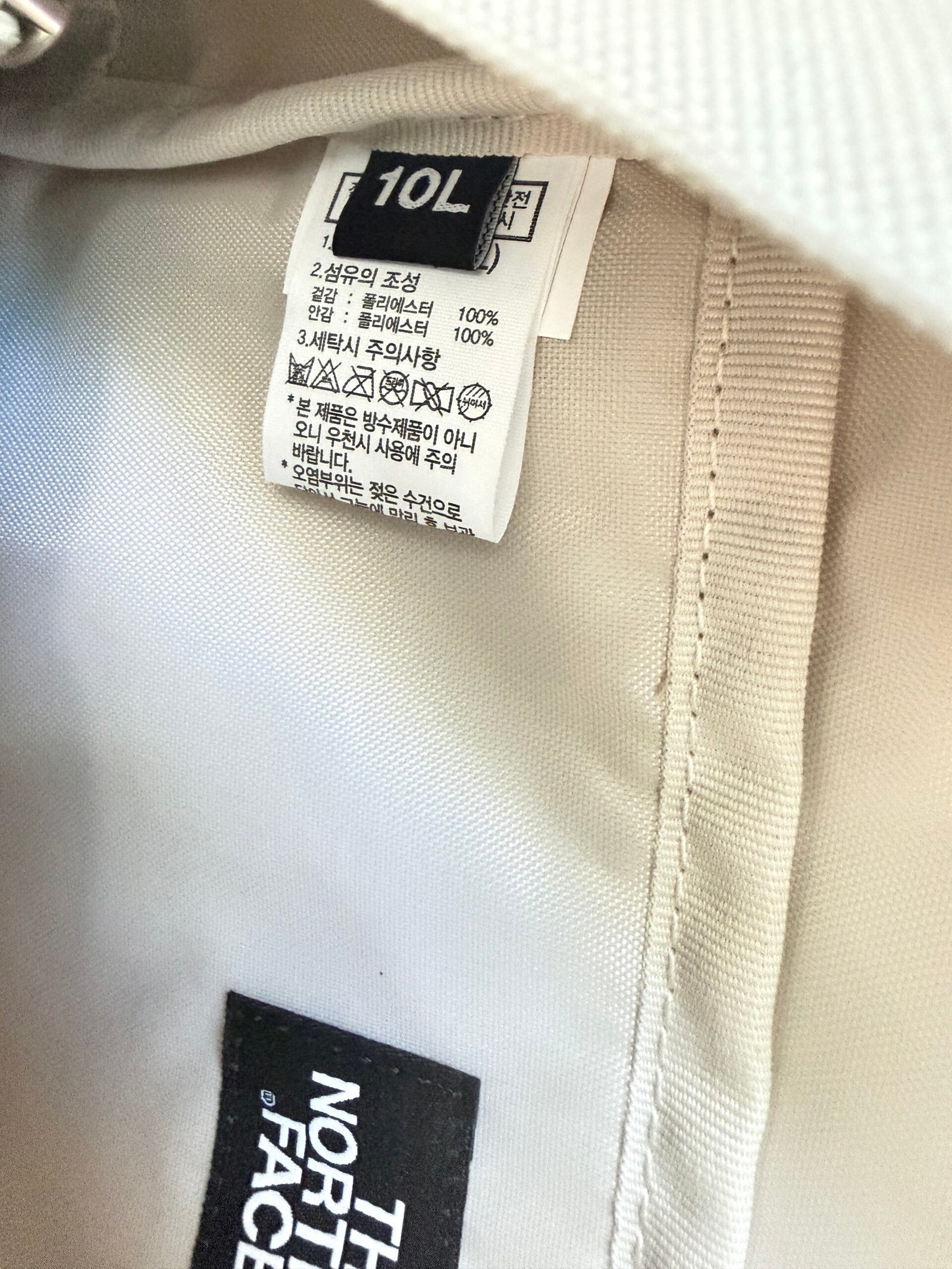
- 겉감 — outer fabric: polyester 100%.
- 안감 — lining: polyester 100%.
- Rain precaution: the visible Korean text says this product is not waterproof and advises caution when using it in rain.
Do not infer waterproof performance from the fabric’s appearance. The lower care text is partly outside this photograph, so this is not a complete transcription of all cleaning instructions.
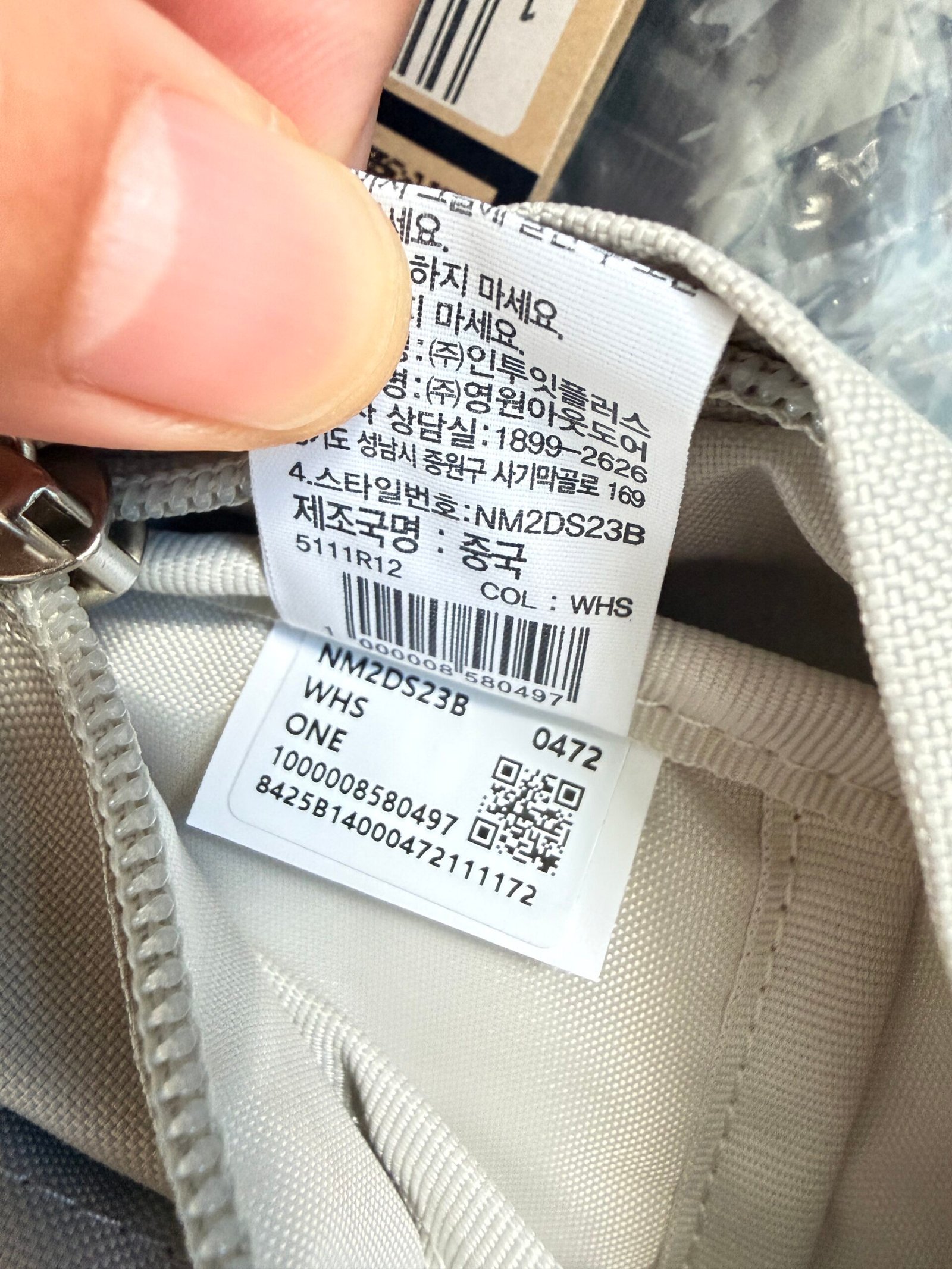
The inside label’s 스타일번호 means style number and matches NM2DS23B on the hangtag; COL: WHS also matches. The field 제조국명: 중국 means country of manufacture: China for this photographed item only. This does not mean that all The North Face products or all Korean-market products are made in China. Manufacturing countries vary by product; always check the country-of-manufacture field on the actual item’s inside label. These matching fields help compare labels for the same item, but do not independently prove authenticity or identify a particular collection.
The ₩89,000 records the printed hangtag price, not a verified current selling price. This example shows why it is useful to photograph both the hangtag and the inside labels: the first identifies the item and nominal size, while the others add capacity, composition, origin and handling precautions.
What Barcodes and QR Codes Can — and Cannot — Prove
A barcode usually identifies a retail item or stock-keeping unit. A QR code may lead to a brand information page, campaign, product record or another service. Both can be useful supporting references.
However, neither should be treated as automatic proof of authenticity. Printed codes can be copied, links can change and older products may no longer have an active online page. A stronger check combines several signals:
- the full style code and product name;
- matching color and size information;
- the permanent care label and fiber composition;
- the manufacturer, importer or distributor details;
- consistent construction, packaging and branding;
- the seller’s identity and purchase source.
See our practical guide to buying authentic The North Face Korea products for a broader verification process.
Country of Manufacture vs. Brand Origin
제조국명 tells you where the physical product was manufactured. It does not tell you where the brand was founded, where the design team is based or which regional collection the item belongs to.
A Korean-market product can legitimately be manufactured in Korea, Vietnam, China, Bangladesh, Thailand or another country. The country alone is not a reliable authenticity test. Compare it with the rest of the label and the information supplied for that particular style.
Why the Permanent Care Label Matters
Korea’s Product Safety Information Center explains that clothing labeling for relevant everyday textile products can include fiber composition, manufacturer or importer, country of manufacture, manufacture date, dimensions and care precautions. The permanent care label is therefore more important than a removable price tag when you want to understand materials and maintenance.
If a reseller shows only the front logo and a barcode sticker, ask for the inside label. For used clothing, a missing retail hangtag is normal; a cut-out permanent care label is more significant because it removes material and origin information.
Checklist for International Buyers
- Ask for a clear, uncropped photo of the full hangtag.
- Record the exact 품번 style code, including the final letters.
- Match the product name, color and selected size.
- Check whether the numeric size is a selected size or only a size range.
- Look for the Korean listed price, but do not confuse it with today’s selling price.
- Ask for the permanent care label to check composition, origin and care.
- Compare multiple details instead of trusting one barcode or QR code.
- Protect personal information: receipts should have names, addresses and order numbers covered before sharing.
When Two Labels Do Not Seem to Match
| What you notice | What to check next | What not to assume |
|---|---|---|
| The hangtag says ONE, but an inside tab says 10L. | Read the field: ONE is the size designation and 10L is labeled capacity in the photographed backpack. | These are not conflicting dimensions or a laptop-fit guarantee. |
| A Korean importer is named, but the origin label says China. | Compare 수입자명 or 수입원 with 제조국명. They describe the importing business and manufacturing country respectively. | An importer address does not mean the item was made there; origin varies by product. |
| The tag lists several sizes, but the seller offers only one. | Separate the selected size from the printed size run, then ask which size is actually in stock. | The printed range is not live inventory. |
| The hangtag and sewn-in label show different style or color codes. | Request uncropped photographs of both labels with the full item, and ask the seller to explain the difference before ordering. | Do not resolve a mismatch using the front logo alone or guess what a final letter means. |
| The product name or care text is cut off. | Ask for another photo showing the missing line and the reverse of the label. | Do not reconstruct unseen words or cleaning instructions from another product. |
For a product-information question, send a free inquiry with the full product photo, hangtag, inside label and the specific mismatch you want explained. We can help interpret readable information; photographs alone do not support an authenticity certificate. Cover personal details on receipts and shipping labels.
Official Sources
- Safety Korea — Products Subject to Compliance with Safety Standards
- Korean Agency for Technology and Standards — Textile Product Labeling Notice
- Korea Legislation Research Institute — Act on Fair Labeling and Advertising
All product photos in this guide were taken by Korean Brand Guide from items handled in Korea. Brand names and trademarks belong to their respective owners. This independent guide is not affiliated with the featured brands.