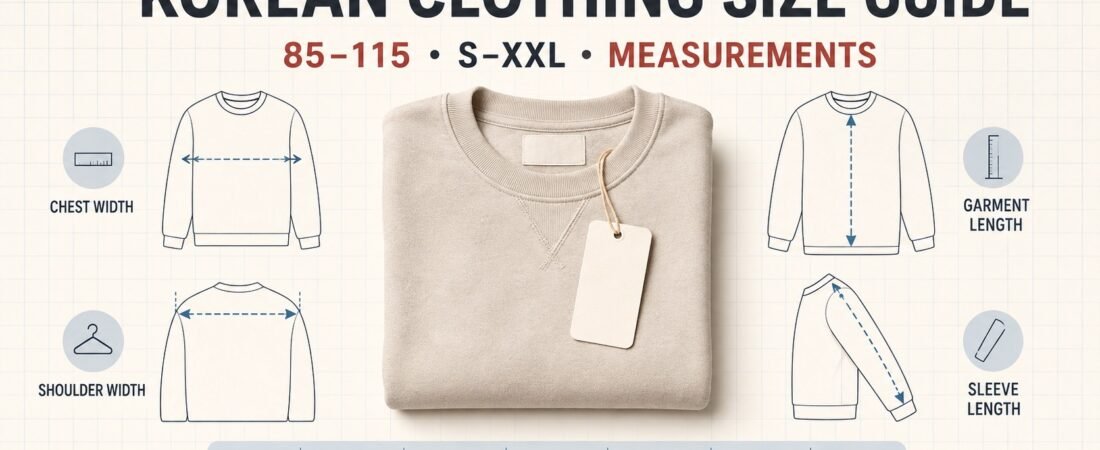
Quick answer: This Korean clothing size guide explains why there is no single conversion that works for every brand. Numbers such as 85, 90, 95, 100, 105, 110 and 115 identify positions within a brand’s size range, but the matching letter and actual garment measurements can change by gender, product category and fit. The safest method is to measure a similar item you own and compare it with the exact Korean product page.
Independent guide. Korean Brand Guide is not affiliated with any brand or retailer mentioned here. Size information was checked in September 2026 and may change by style, season and market. Always use the chart for the exact product code.
If you are trying to understand the Korean words printed beside a size, style code, color or retail price, read our guide to Korean clothing labels.
Contents
- Korean XXL: women’s, men’s and measurements
- Why there is no universal Korean conversion
- Common Korean number patterns
- Real brand examples
- How to measure correctly
- Korean measurement terms
- Tops, bottoms, shoes and kids’ sizes
- Oversized, unisex and cropped fits
- Online shopping checklist
- Frequently asked questions
What Is Korean XXL? Women’s and Men’s Sizes Explained
Korean XXL does not have one fixed measurement or US, UK or EU equivalent. Start with the product’s own size chart, not a country-wide conversion. A women’s XXL and a men’s or unisex XXL can use different Korean numbers, and the same letter can have different chest widths and lengths.
Two official examples: 105 (XXL) versus 110 (XXL)
The North Face Korea’s W’S VELIA S/S COVER UP, NT7UR41B, lists 105 (XXL). Its actual-size chart gives a garment chest circumference of 125 cm and total length of 68 cm for that size. Those are product measurements, not a recommended body chest size. In contrast, the official DELPHIE S/S R/TEE, NT7UR02K, lists 110 (XXL). These examples illustrate different label systems; they do not establish that the two garments fit alike or that either is currently in stock.
How many centimeters is Korean XXL?
There is no single answer without the model and measurement type. Look for whether the chart describes your body, the finished garment circumference, or a flat width. A label of 110 (XXL) alone is not proof that the garment measures 110 cm around the chest. Do not double a circumference measurement; only double a flat width when the chart’s method makes that comparison appropriate.
Can I convert Korean XXL to my usual US, UK or EU size?
Do not automatically convert it to a smaller international letter size. Compare the exact Korean item with a similar garment that already fits you: use chest width, length and shoulder width for tops, and waist, hip and rise for bottoms. Keep the measurement method consistent. For a women’s top, also check whether the cut is fitted, cropped or oversized; a generous chest measurement does not guarantee enough length.
For more brand-specific examples, see our The North Face Korea size guide and the photographed XXL (110) tag in the National Geographic example below.
Why There Is No Universal Korean Clothing Size Conversion
Korean fashion listings commonly combine a number with a letter, for example 095 (M) or 110 (XXL). It is tempting to treat the number as a fixed international size or a literal body measurement. In practice, neither assumption is reliable.
The same number can mean different things in different product systems. On many men’s or unisex tops, 95 is labeled M. On many women’s tops, 95 may be labeled L. In some pants ranges, 95 can appear at the large end of the sequence. The finished chest measurement can also be much larger than 95 cm because the label is not necessarily the garment circumference.
Fit intent creates another difference. A regular T-shirt, oversized sweatshirt, cropped women’s top and insulated jacket can all carry the same letter while having very different width and length. This is why a brand-level conversion chart should be treated as a starting point, not a guarantee.
Common Korean Clothing Size Number Patterns
The patterns below are frequently seen in Korean fashion, but they are examples rather than universal rules.
| Product range | Common sequence | Important caution |
|---|---|---|
| Men’s or unisex tops | 90, 95, 100, 105, 110 | Often paired with S–XXL, but not identically across brands |
| Women’s tops | 85, 90, 95, 100 | The same number may map to a different letter than a men’s item |
| Extended adult ranges | 80–115 | Check whether the chart is Korean, regional or international |
| Women’s denim | 25, 26, 27, 28 and above | Compare the flat waist, hip and rise measurements |
| Adult shoes | 230, 240, 250, 260, 270, 280 mm | Measure foot length and check the brand’s fit note |
| Kids’ clothing | 100, 110, 120, 130, 140, 150, 160 | Often related to height ranges, but age alone is unreliable |
A useful rule is to record the complete label, not just one part of it. “100 (L), men’s regular fit” is much more informative than simply “100.” Also record the product code because a new season or a women-specific version can use a different chart.
Real Examples From Korean Brand Size Charts and Tags
The North Face Korea
The North Face Korea shows why one number cannot be converted in isolation. Many men’s or unisex tops use 090 (S), 095 (M), 100 (L), 105 (XL) and 110 (XXL). Many women’s tops instead use 085 (S), 090 (M), 095 (L), 100 (XL) and 105 (XXL). Some pants use another sequence again.
See our detailed The North Face Korea size guide for product-specific examples covering clothing, pants, shoes and kids’ sizing.
National Geographic Korea
The photographed Korean-market National Geographic tag identifies style N265UTS020 as XXL (110). It prints a size range of 90, 95, 100, 105, 110 and 115; that is label information, not a statement of current stock. This tag confirms the pairing for this item only. Do not subtract one letter to convert every Korean size into a US or Australian size: use the exact product and market chart instead.
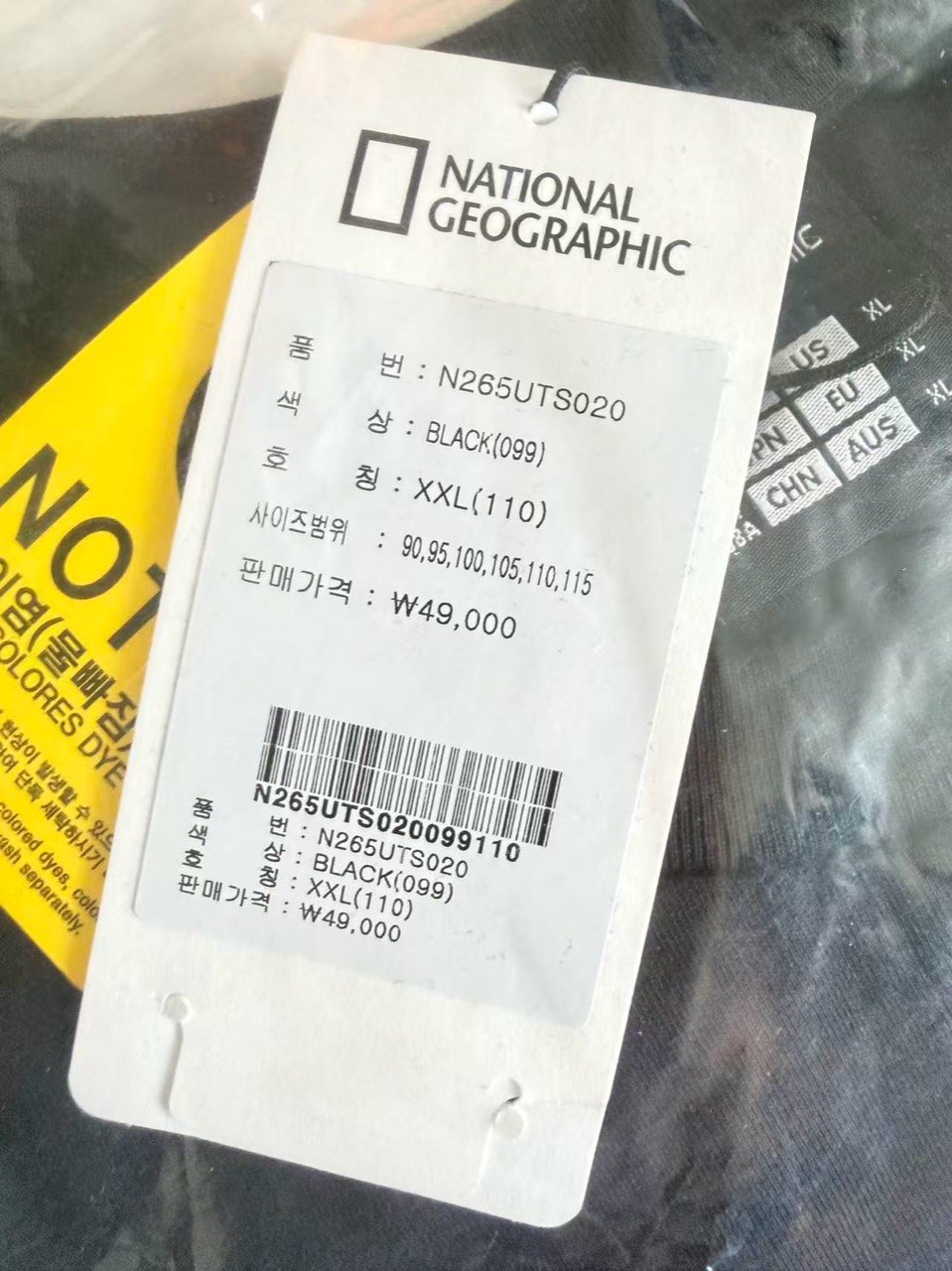
Read the full National Geographic Korea size guide for the original tag photographs and product-specific fit guidance.
Marithé François Girbaud Korea
Marithé Korea often uses familiar letters such as XS, S, M, L and XL, but a familiar letter alone does not establish fit. When the exact product listing provides flat garment measurements, use those measurements and its diagram. A regular unisex T-shirt, women’s classic T-shirt and oversized sweatshirt can all be size S while having substantially different chest widths and lengths. Denim uses waist-style numbers, but the measured waist and hip still take priority.
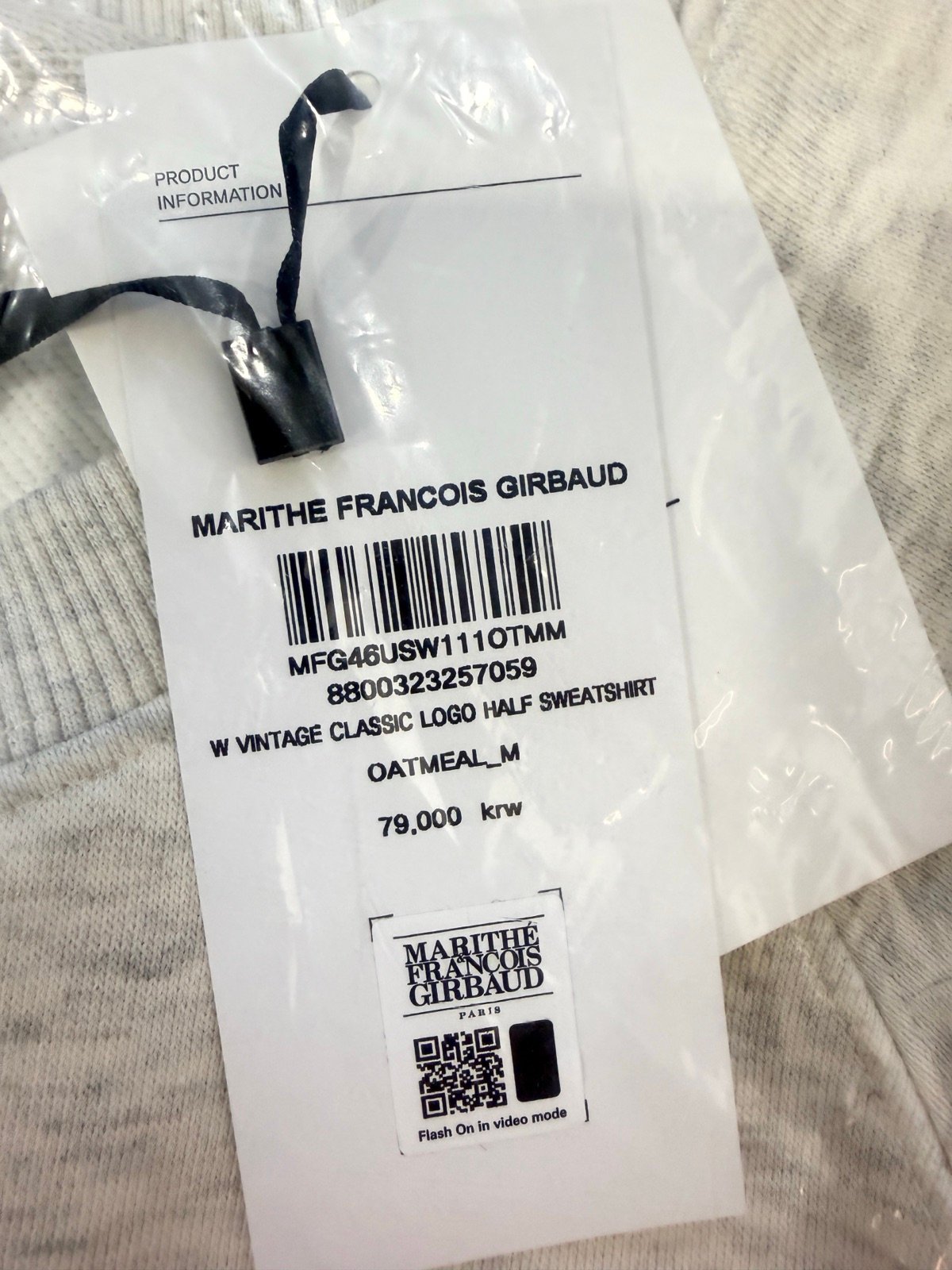
Use our Marithé Korea size guide to compare T-shirts, sweatshirts and denim using the official flat measurements.
How to Measure for Korean Clothing
The most reliable comparison is garment to garment. Choose an item you already own that fits the way you want, lay it flat without stretching it and measure the same points shown on the Korean listing.
- Choose the same product type: compare a sweatshirt with a sweatshirt, not with a fitted shirt.
- Button or zip the garment and smooth it naturally on a flat surface.
- Measure chest width at the points shown in the product diagram; use armpit to armpit only when that is the stated method.
- Measure total length from the chart’s stated starting point to the hem; a shoulder-point measurement is not interchangeable with a centre-back measurement.
- Measure shoulder width between the shoulder seams.
- Measure sleeve length using the same starting point shown by the brand.
- For pants, compare waist, hip, rise, thigh and inseam.
- Compare your numbers with the exact style’s chart and allow for the intended fit and layering.
Many Korean stores provide flat measurements in centimeters. A flat chest width of 50 cm is approximately 100 cm around the garment when doubled, but construction, lining and stretch can affect usable room. To convert centimeters to inches, divide by 2.54.
Worked example: 50 cm is not the same kind of number as 100 cm
Suppose your own T-shirt measures 50 cm across the chest when laid flat. Compare that with a listing’s flat chest width measured at the same points. A listed 100 cm garment circumference may describe approximately the same width, but a 100 cm recommended body chest is a different measurement: it does not tell you the finished garment’s room. This is a hypothetical example, not a size recommendation for any photographed product. If the chart does not identify the measurement type, ask the seller before choosing.
Useful Korean Size-Chart Terms
| Korean | English | How to read it |
|---|---|---|
| 사이즈 | Size | The labeled size or available size range |
| 총장 / 총길이 | Total length | Follow the diagram’s starting point and hem endpoint |
| 어깨 / 어깨너비 | Shoulder width | Across the shoulder seam points |
| 가슴 / 가슴너비 | Chest / chest width | Check whether the value is body circumference, garment circumference or flat width; 가슴 alone does not resolve this |
| 소매길이 | Sleeve length | Check the diagram for the starting point |
| 허리 / 허리너비 | Waist / waist width | Confirm circumference versus flat width, and relaxed versus stretched measurement |
| 엉덩이 / 엉덩이너비 | Hip width | Across the widest hip area |
| 밑위 / 밑위길이 | Rise | Crotch seam to top of waistband |
| 밑단 | Hem width | Across the garment’s lower opening |
| 실측 | Actual measurement | Garment measurements rather than a conversion |
Sizing by Product Category
T-Shirts, Sweatshirts and Jackets
Prioritize chest width and total length. Shoulder width helps identify dropped-shoulder or fitted construction. For winter outerwear, compare with a jacket that already leaves enough room for your usual layers.
Pants and Denim
Do not rely only on the printed waist number. Compare the flat waist, hip, front rise, thigh width and inseam. Elastic waists and stretch denim may include both relaxed and stretched measurements.
Shoes
Korean adult shoes usually display millimeters. A label of 250 mm refers to the size system, but width, toe shape, lining and intended use still affect fit. Measure both feet while standing, use the larger measurement and follow any model-specific recommendation.
Kids’ Clothing
Kids’ labels such as 120 or 140 often relate broadly to height, but children of the same height can have different builds. Check height, chest, waist and garment length instead of choosing by age alone, especially for school jackets and padded outerwear.
Oversized, Unisex, Women’s and Cropped Fits
- Oversized: intentionally adds chest width and often dropped shoulders. Sizing down changes both width and length.
- Unisex: does not mean one universal fit. Compare measurements and the model’s listed size.
- Women-specific: may be narrower, shorter or more shaped than a unisex item with the same number.
- Cropped: chest width can look generous while total length is much shorter.
- Layering fit: outerwear needs enough room for the clothing you expect to wear underneath.
If you are between sizes, decide which measurement matters most. For a sweatshirt, you may prioritize chest room; for trousers, the waist, hip and rise may be more important. Compare the larger size too, because extra width may come with unwanted sleeve or body length.
Checklist Before Buying Korean Clothing Online
- Confirm the full brand name, product name and style code.
- Identify whether the item is men’s, women’s, kids’ or unisex.
- Read the letter and number together.
- Check whether measurements are body measurements or flat garment measurements.
- Compare with the same type of garment you already own.
- Read the fit description: regular, slim, semi-overfit, oversized or cropped.
- Allow for the store’s stated measurement tolerance.
- Check fabric stretch, lining and intended layers.
- Review the return policy before ordering internationally.
Frequently Asked Questions
What is Korean size 95 in US sizing?
There is no single conversion. It is often M in a men’s or unisex top, but it may be L in a women’s range or something different in pants. Check the gender category, letter mapping and measurements for the exact product.
Is Korean size 100 a large?
It is commonly labeled L in many men’s or unisex tops, but that does not guarantee the same fit as an international large. The finished garment dimensions and fit description are more reliable.
Do Korean clothes run small?
Some Korean ranges are narrower or use a different letter conversion, but “Korean clothes run small” is too broad to be a dependable rule. Oversized Korean styles can be very roomy. Compare actual measurements.
Should I size up when buying from Korea?
Not automatically. Size up only when the measurements, fit description or your layering preference support that choice. An oversized item may already provide enough room.
Are Korean product measurements taken flat?
Many Korean fashion stores publish flat garment measurements, but always read the chart note. A flat width is normally one side of the garment and may need to be doubled to estimate circumference.
What does ONE or FREE mean?
It means the item is sold in one listed size, not that it will fit everyone. Check the product’s actual dimensions, strap adjustment or stretch range.
How accurate are Korean size charts?
They are most useful when they belong to the exact style and explain how measurements were taken. Small manufacturing or measuring differences are normal, so respect the brand’s stated tolerance.
What information should I send a Korean seller?
Send the complete style code, color, labeled size and the specific measurement you need. A message asking only whether an item is “true to size” gives the seller too little context.
Final Advice
Treat Korean size numbers as labels within a product system, not as universal conversions. Start with the exact product code, confirm the category and intended fit, then compare like-for-like measurements. Use garment dimensions against a similar item you own, or your body measurements against a chart explicitly labeled as body measurements. That method is slower than choosing from a generic S–XL chart, but it is far more reliable for international orders.
Need Help Reading a Korean Size Chart?
Contact us for free help interpreting the product’s size information. Send the product link or full style code, the size you are considering, a screenshot of its size chart, and the measurements of a similar garment that fits you. Tell us whether you prefer a fitted or relaxed cut. You do not need to send body photos.
We can help explain the available labels and measurements, but cannot guarantee fit or supply measurements the brand has not published. If information is missing, we will say so. For buying options, see our country-specific Shopee shop links; listing availability and delivery coverage must be checked on your local platform.