Quick answer: National Geographic Korea product codes and tags normally give you several separate identifiers: the style ID, product name, color or color code, size, Korean retail price and barcode. Use the complete style ID as your main lookup key. Do not treat a barcode, QR code or one matching label as proof of authenticity by itself.
Independent guide. Korean Brand Guide is not affiliated with National Geographic, The Nature Holdings or any retailer. This article uses an original Korean-market product photographed by our team and official regional product information checked in September 2026.
For a general translation of the Korean fields used across clothing brands, see our Korean clothing labels guide.
Contents
- Why product codes matter
- A real Korean tag example
- How to read each field
- Style ID versus barcode
- Color codes and regional differences
- Size, capacity and price
- How to cross-check a product
- What a tag can and cannot prove
- Evidence limits for this photograph
Why National Geographic Korea Product Codes Matter
National Geographic Apparel Korea sells regionally developed clothing, shoes, bags, luggage, kids’ products and camping equipment. The Korean apparel business is operated under license by The Nature Holdings. Because Korean-market products can differ from merchandise sold in other countries, the exact product code is often more useful than a translated product name.
A shopper may see several black sling bags described with nearly identical English titles. A seller may shorten a Korean name, translate it differently or reuse a generic phrase such as “National Geographic crossbody bag.” The style ID lets you search for the specific model instead of relying on the listing title alone.
Codes are also useful when comparing colors, dimensions and release information. However, they are reference tools—not automatic authenticity certificates. A copied label can repeat a real code, so the code must agree with the physical product and the seller’s evidence.
Real Example: N265ACR070 Pachi Sling Bag
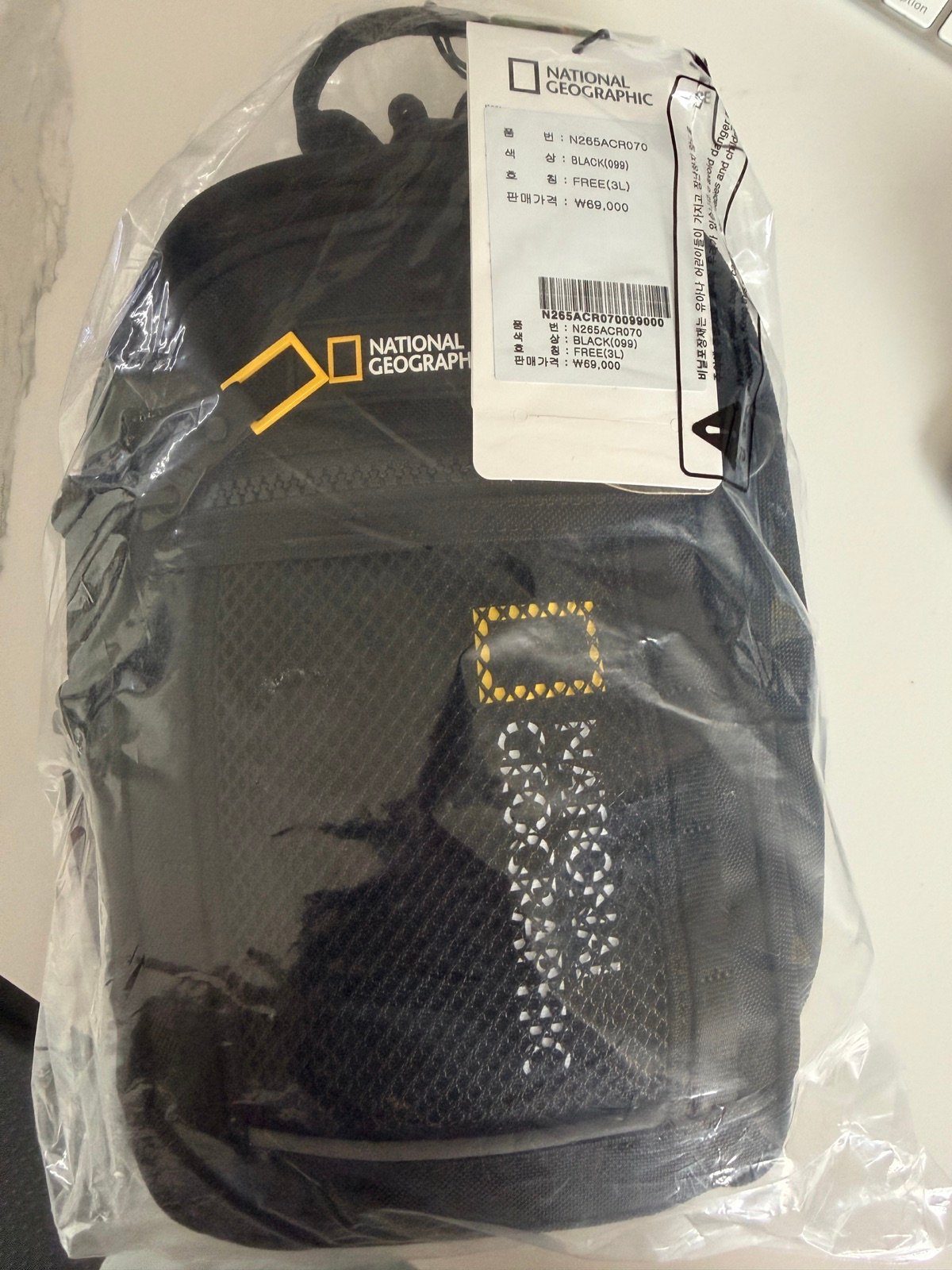
Our photographed Korean product is a black National Geographic sling bag. Its tag shows the following information:
| Tag field | Printed value | Meaning |
|---|---|---|
| Style ID | N265ACR070 | Exact model reference |
| Product name | Not shown on the photographed tag | Pachi Sling Bag is the name used in the official regional listing discussed below, not a transcription of this tag |
| Color | BLACK (099) | Color name and Korean-market color code |
| Size | FREE (3L) | One-size bag with a stated 3-liter capacity |
| Retail price | ₩69,000 | Korean printed list price for this item |
An official National Geographic regional store page lists the same style ID, N265ACR070, for the Pachi Sling Bag. That page describes a white version with color code 010 and gives dimensions of 16.5 cm wide, 26 cm high and 8 cm deep, with a 3-liter capacity. This is a limited cross-check: the listed style ID and capacity agree, while the color differs. The 16.5 × 26 × 8 cm dimensions belong to that Malaysia white-product listing; they are not measurements we took from the photographed black bag.
How to Read Common Korean Tag Fields
| Korean | English | What to check |
|---|---|---|
| 품번 | Style number / product code | Search the complete letter-and-number string |
| 품명 | Product name | Compare the model name with official listings |
| 색상 | Color | Check both the name and numeric code |
| 사이즈 / 호칭 | Size | May be a garment size, shoe size or FREE |
| 판매가격 | Retail price | Usually shown in Korean won |
| 제조국명 | Country of manufacture | Do not confuse manufacturing country with brand origin |
| 수입자명 | Importer | May appear on imported products |
| 판매자명 | Seller / distributor | Can help identify Korean distribution information |
Not every tag uses exactly the same layout. Bags, footwear and apparel require different size and material information, and tags can change between seasons. Read the labels as a set rather than expecting one universal design.
Style ID, Barcode and QR Code Are Not the Same
When reading National Geographic Korea product codes, the style ID is the model reference used to identify the product. For this bag, it is N265ACR070. Copy the entire string exactly, including letters and leading zeros, when searching an official store or comparing seller listings.
The text printed beneath a barcode is not necessarily a separate all-numeric identifier. In this photograph it reads N265ACR070099000: the visible style ID N265ACR070 appears at the start, followed by 099000. The separately printed color field confirms BLACK (099), but this photograph alone does not establish a universal meaning for the final 000. We have read the printed text, not electronically decoded the barcode.
A QR code may lead to product information, a campaign page or another brand-managed destination. A working QR code is helpful, but it is not conclusive proof that the physical item is genuine. URLs and graphics can be copied. Check the destination domain and compare the product itself.
We have not verified an official reference explaining every character in all Korean style IDs. Avoid confident claims that one character always identifies a year, season or category unless an official source for that exact coding system is available. The safest method is to use the complete code as a lookup key.
Color Codes and Regional Product Differences
The photographed black Pachi Sling Bag shows BLACK (099). The official regional white listing uses color code 010. This demonstrates why the style ID alone is not enough when comparing two listings: confirm the color name, code and product photos together.
When comparing National Geographic Korea product codes across regions, stores may translate names differently, use different currencies or display a subset of colors. Matching the style ID, silhouette, capacity and construction details is more informative than matching only the logo, but does not prove identical regional specifications. If one letter differs, record both complete codes and ask the seller or brand to explain the difference; do not invent a letter-substitution rule.
How to Read Size, Capacity and Korean Price
For accessories, FREE usually means the product is sold in one standard size. It does not mean the bag has no measurements. The capacity and dimensions still matter. In this example, the tag states 3L. That is a printed capacity claim, not a capacity test. The Malaysia listing gives dimensions for its white version; verify the dimensions of the exact item you will receive.
For clothing, a tag may use Korean numeric sizing such as 90, 95, 100 or 105. Those numbers should not be converted blindly into S, M, L or XL. Use the exact garment measurements on the official product page. For shoes, Korean sizes are commonly shown in millimeters, such as 250 mm or 280 mm.
The printed price of ₩69,000 is a Korean list price associated with this product tag. It is not necessarily the current selling price. Discounts, outlets, season changes and resale markups can all produce a different final price. A low or high price alone does not determine authenticity.
A Practical Five-Step Cross-Check
- Copy the complete style ID. Search the exact string in quotation marks or on an official regional store.
- Match the product category and silhouette. A code linked to a sling bag should not appear on a jacket or cap.
- Compare the color information. Check the printed color name, numeric color code and visible material.
- Compare size or capacity. For a bag, check liters and dimensions; for clothing, compare the official measurement table.
- Evaluate the seller and purchase evidence. Prefer official stores, authorized retailers or sellers who can show consistent product, tag and purchase information.
If an old product no longer appears in the Korean online store, look for an archived official regional page or contact an official store with the exact style ID. Absence from the current catalog does not automatically mean a product is counterfeit; seasonal items are regularly removed.
What a Product Tag Can—and Cannot—Prove
A consistent tag is useful evidence. The style ID, model name, color, size and price should make sense together. Printing should be legible, and the attached tag should correspond to the item in the photos.
But a tag is only one part of an authenticity review. Counterfeit goods can copy real model numbers, barcodes and QR graphics. Also examine construction, logos, materials, stitching, packaging, seller history and the purchase route. When the purchase value is high or evidence conflicts, ask an official retailer or brand customer-service channel for guidance.
For more background on the licensed Korean operation, product categories and official buying routes, read our complete National Geographic Korea guide.
If you are decoding a clothing size such as 95, 100, 105 or 110, use our National Geographic Korea size guide before comparing the measurements.
Evidence Limits for This Photograph
| Visible evidence | What we can report | What remains unverified |
|---|---|---|
| 품번: N265ACR070 | The printed style reference | Whether every regional version has identical construction |
| 색상: BLACK(099) | The tag’s black color designation | A universal color-code system for every brand or season |
| 호칭: FREE(3L) | The stated size and capacity | Internal dimensions, usable capacity or what fits inside |
| 판매가격: ₩69,000 | The printed price on this tag | Current selling price or amount actually paid |
| Barcode text: N265ACR070099000 | The visible letter-and-number string | An electronic scan result or an authenticity certificate |
The displayed photograph does not show a readable manufacturing-country label. Do not infer the country of manufacture from the Korean language, brand license or sales market. Request a clear photograph of the origin label for the particular item.
Need Help Identifying a National Geographic Korea Product?
Individual buyers: Use our free inquiry page if you need help reading a National Geographic Korea product tag or comparing a seller listing with the available product information. Send the complete style code, clear photos of the product and every label, plus the seller link. We can explain the visible information and point out inconsistencies, but we cannot guarantee authenticity, seller reliability, stock or fit.
Retailers, group buyers and live-commerce teams: If you need repeat supply, multiple Korean products or an arranged Korea live-selling visit, read our Korean fashion sourcing and live-commerce support guide and send a structured commercial request.
Official Sources
- Official National Geographic regional store — Pachi Sling Bag N265ACR070
- The Nature Holdings — official National Geographic Apparel brand overview
- The Nature Holdings — company history and licensing timeline
- Official National Geographic Apparel Korea store locator
Photo transcription rechecked: September 27, 2026. Original photograph retained; no barcode scan, capacity measurement or authentication test is claimed. Product pages, prices and availability can change.